
When something is bothering your child, asking, “What’s wrong?” doesn’t always lead to an answer.
Sometimes the response is “I don’t know.” Sometimes it’s silence. Other times, what a child is feeling shows up somewhere else entirely: bedtime struggles, angry outbursts, withdrawal, stomachaches, difficulty at school, or behavior that seems to come out of nowhere.
That doesn’t necessarily mean a child is unwilling to communicate. Children simply don’t always process or express experiences through words in the same way adults do.
Play therapy gives children another way to communicate.
What is play therapy?
Play therapy is a therapeutic approach that uses play within a structured counseling relationship to help children explore emotions, experiences, relationships, and challenges.
For a child, toys, art, games, stories, movement, and imagination can become part of the way they communicate.
That doesn’t mean a play therapy session is simply free time in a room full of toys. A trained play therapist pays attention to the child’s choices, patterns, emotions, interactions, and needs while creating an environment in which the child can safely explore what is happening in their world.
The Association for Play Therapy describes play therapy as a way to help clients address psychosocial difficulties and support healthy growth and development through the therapeutic use of play.
Why use play instead of simply talking?
Adults have spent decades developing a vocabulary for complex experiences. Even then, finding the right words can be difficult. Children are still developing those skills.
A child may know that school feels overwhelming without knowing how to describe anxiety. They may recognize that something changed after a divorce, move, loss, or frightening experience without understanding exactly why they now feel angry or afraid.
Play can create a bridge between an internal experience and something the child can express externally. Through play, children may be able to explore feelings, practice new responses, make sense of experiences, and develop a stronger sense of control in ways that feel more natural than sitting down for a traditional conversation.
What can play therapy help with?
Families seek play therapy for many different reasons. A child doesn’t need to have a specific diagnosis to benefit from counseling, and one behavior on its own doesn’t necessarily indicate a mental health condition.
- Anxiety, fears, or excessive worry
- Difficulty regulating strong emotions
- Anger or frequent emotional outbursts
- Behavioral concerns at home or school
- Grief and loss
- Family separation or divorce
- Trauma or frightening experiences
- Changes in family circumstances
- Low self-esteem
- Social or peer difficulties
- ADHD-related emotional or behavioral challenges
- Difficulty adjusting to a major transition
The goal isn’t to make every uncomfortable emotion disappear. Children need a full range of emotions. Instead, therapy can help children understand what they’re experiencing, develop healthier coping strategies, and feel more capable of navigating difficult situations.

What actually happens during a play therapy session?
Every child and every therapist is different, so there’s no single script for a play therapy appointment.
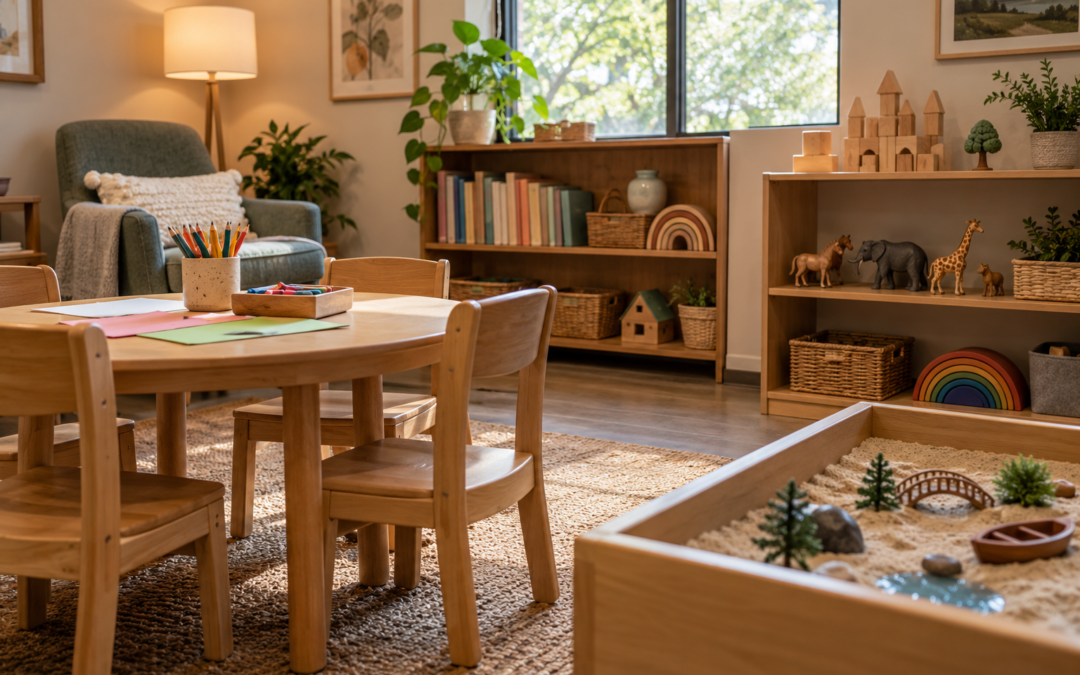
A therapy room may include art supplies, figures, puppets, games, sensory materials, a sand tray, books, or other tools that allow a child to communicate and explore.
Depending on the therapist’s approach and the child’s needs, a session may be more child-led or may include specific therapeutic activities. The therapist might notice themes that repeatedly appear in the child’s play, help the child identify emotions, practice problem-solving, or create opportunities to explore situations in a way that feels manageable.
Importantly, the relationship between the child and therapist remains central to the process. A child needs to feel safe enough to be themselves before meaningful therapeutic work can happen.
Are parents involved in play therapy?
Often, yes. Parent and caregiver involvement can be an important part of counseling for children, although the level of involvement varies according to the child’s age, needs, and treatment plan.
Parents may meet with the therapist to discuss what they’re noticing at home, changes in behavior, family circumstances, or concerns from school. The therapist may also provide parents with strategies to reinforce skills outside the therapy room.
At the same time, children need an appropriate level of privacy in therapy so they can develop trust with their counselor. A therapist can explain how confidentiality works for your child, what information will typically be shared with parents, and when safety concerns require additional communication.
How do I know whether my child might benefit from counseling?
There’s no single behavior that tells a parent, “It’s definitely time for therapy.” Instead, consider patterns.
Has something changed significantly from your child’s usual behavior? Is the concern continuing rather than resolving? Is it affecting school, friendships, sleep, family life, or activities they normally enjoy?
You may also simply feel that your child is having a difficult time and could benefit from another safe adult in their corner. You don’t need to have everything figured out before contacting a counselor. An initial conversation can help determine whether therapy is appropriate and what type of support may fit your child best.
Does play therapy only work for young children?
Play therapy is most closely associated with children because play is such a natural part of childhood communication and development. However, expressive and activity-based therapeutic techniques can also be helpful for preteens, teenagers, and adults.
As children grow, the way those techniques are incorporated into counseling changes. A therapist should always choose an approach based on the individual client rather than assuming one method is right for everyone.
Finding play therapy in New Braunfels
Choosing a therapist for your child is a personal decision. Parents may want to ask about the therapist’s clinical license, experience working with children, specialized play-therapy education, and how parents or caregivers are incorporated into treatment.
Registered Play Therapists and Registered Play Therapist-Supervisors complete additional education, clinical experience, and supervision related specifically to therapeutic play.
Allison & Associates Counseling works with children, teens, adults, and families in New Braunfels using approaches tailored to each client. The practice includes clinicians with specialized play-therapy credentials, including Kristalyn Allison, MSW, LCSW-S, RPT-S, and Brianna Murphy, LPC, RPT.
If you’re concerned about something your child is experiencing or wondering whether play therapy could be a good fit, contact Allison & Associates Counseling or call (830) 620-1175 to discuss the next step. The practice is located at 1985 FM 758 in New Braunfels.
You don’t have to determine exactly what kind of therapy your child needs before reaching out. That’s something you can explore with the counseling team.
Sources and further reading
Association for Play Therapy: Why Play Therapy? • Allison & Associates Counseling: Therapy for Everyone • Allison & Associates Counseling: Brianna Murphy, LPC, RPT